Gayther
How the Worldwide LGBTQIA+ Population Index was calculated
Helping you to understand how the global population relating to the LGBTQIA+ community was calculated
Discover all of the gay, lesbian, bisexual, transgender, and all groups with non-traditional gender and sexual identities, collectively known as the LGBTQIA+ community, living in countries, sub-regions and continents across the globe. With no official world census, estimates of the community’s population vary by country and source. Estimates range from 2% to as high as 15% of the world’s total population.
The LGBTQIA+ Population index is collated using conservative estimates, and the figures are based on those reported and published by each country annually. Though conservative, it is likely that the actual global population relating to the community is much more significant due to more countries becoming more inclusive and introducing laws and protections relating to the LGBTQIA+ communities.
Through years of research and vocal advocates and pioneers from within the LGBTQIA+ community, the world is starting to understand that sexual or gender identities are not something a person chooses. Instead, you are simply born that way. With no official censuses, it is hard to establish the actual size of the worldwide LGBTQIA+ community, with many hiding their true identity for fear of persecution
The LGBTQIA+ Population index is collated using conservative estimates, and the figures are based on those reported and published by each country annually. Though conservative, it is likely that the actual global population relating to the community is much more significant due to more countries becoming more inclusive and introducing laws and protections relating to the LGBTQIA+ communities.
Through years of research and vocal advocates and pioneers from within the LGBTQIA+ community, the world is starting to understand that sexual or gender identities are not something a person chooses. Instead, you are simply born that way. With no official censuses, it is hard to establish the actual size of the worldwide LGBTQIA+ community, with many hiding their true identity for fear of persecution
CONTENTS
1 | GENERAL PRINCIPLES
2 | WORLD POPULATION
3 | LGBTQIA+ POPULATION
4 | ABOUT
UPDATE
MORE
SHARE
Understand the size of the community within any given country, region or continent worldwide with this easy-to-use guide, which ranks individual countries by estimated LGBTQIA+ population
section
one
THE TECHNICAL EXPLANATION
Country population statistics are typically established by using:
By combining all of those various factors, it is easy to establish the number of people living in any given country for a specific point of time, their gender and age; however, to understand more about a person, governments will often carry out censuses where more detailed information is obtained. Censuses are expensive and time-consuming to arrange, so typically, they are not carried out frequently, usually any period from five to ten years or more between each census.
The questions asked in the census help to understand more about attitudes, behaviours and preferences; however, there has been no official world census regarding the LGBTQIA+ community. Research and studies have been carried out in which the estimates of LGBTQIA+ individuals range dramatically, with some estimating as high as 15% of the population identifying as LGBTQIA+ in one particular country. With no official census or the means to accurately capture the actual number of LGBTG+ individuals, it is necessary to provide reasonable estimates.
POPULATION STATISTICS
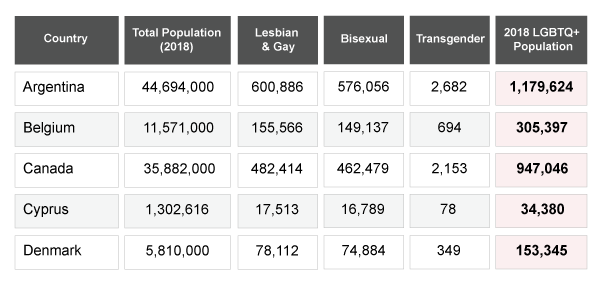
The LGBTQIA+ population volumes are based on several averages that helped us to establish the following conservative estimates against the total population:
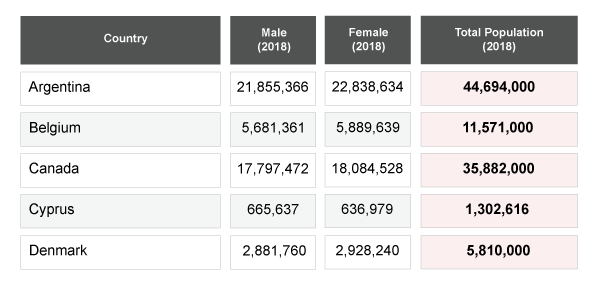
The index has been compiled from country-specific information obtained from the U.S. Census Bureau |International Programs | International Database
Country population statistics are typically established by using:
- The total number of individuals that were living in that country for the previous year
- The total number of births and deaths
- The total number of people that have left the country (emigrated) and those that have moved to the country (immigrated)
By combining all of those various factors, it is easy to establish the number of people living in any given country for a specific point of time, their gender and age; however, to understand more about a person, governments will often carry out censuses where more detailed information is obtained. Censuses are expensive and time-consuming to arrange, so typically, they are not carried out frequently, usually any period from five to ten years or more between each census.
The questions asked in the census help to understand more about attitudes, behaviours and preferences; however, there has been no official world census regarding the LGBTQIA+ community. Research and studies have been carried out in which the estimates of LGBTQIA+ individuals range dramatically, with some estimating as high as 15% of the population identifying as LGBTQIA+ in one particular country. With no official census or the means to accurately capture the actual number of LGBTG+ individuals, it is necessary to provide reasonable estimates.
POPULATION STATISTICS
The LGBTQIA+ population volumes are based on several averages that helped us to establish the following conservative estimates against the total population:
- Lesbian & Gay – 1.3444%
- Bisexual – 1.2889%
- Transgender – 0.0060%
- Total – 2.6393%
The index has been compiled from country-specific information obtained from the U.S. Census Bureau |International Programs | International Database
The LGBTQIA+ Population Index is updated annually, typically in the first six months of the year
Understanding the world around us with
Discover the Gayther Indices, community-related trackers that are among the most comprehensive LGBTQIA+ resources worldwide, covering a wide range of themes from global equality to healthcare systems, to help inform and engage everyone. Whether you are looking for the perfect travel destination or aiming to better understand and support equal rights for community members across the globe, the Gayther Indices are your essential international resource.
section
two
Each year, countries from around the world publish official population statistics. These statistics typically include a breakdown of the genders, age ranges, birth rates, and the total number of people who have moved to and from a country. All of the data is calculated throughout the year. For any given year, it is officially published within the first three months of the following year.
For the LGBTQIA+ population index, we use the official country statistics as the basis on which we apply our LGBTQIA+ community estimates
Extraordinary people
Over the past 50 years, the LGBTQIA+ global community has seen many positive developments, with rights and protections for its members greatly enhanced. These changes are a direct result of the extraordinary individuals who have stood up, often at considerable personal risk, to advocate for and defend community rights. Discover more about some of these remarkable individuals today.
section
three
Now that we have the official country-level population statistics, we can estimate the total worldwide LGBTQIA+ population by applying our estimates.
- We start by multiplying the official population by the estimated Lesbian and Gay ratio (1.34444444444444%)
- We then multiply the official population by the estimated Bisexual ratio (1.28888888888889%)
- Lastly, we multiply the official population by the transgender ratio (0.006%)
- Once we have the volumes for each of the groups, we are now able to establish the total population size for each country
Exceptional and diverse
Discover more about the diverse and extraordinary global LGBTQIA+ community. Find interesting facts, enjoy engaging interactive games, learn about pioneering advocates, and take pride in all sexualities, gender identities, and special groups. Explore everything LGBTQIA+ with Gayther today.
important things to
about the index
Historically, countries worldwide have avoided using sexuality or gender identity-related questions as part of the censuses or electoral rolls. Without the question sets, people from the LGBTQIA+ community cannot be identified and included in official statistics. Though some countries are slowly beginning to include the relevant questions on forms, only a handful of countries encourage community members to be identified and counted in population statistics.
Even with tailored questions relating to the LGBTQIA+ community, there are other barriers, some generational, in which some older community members still find it hard to be open about their gender or sexuality on official polls and censuses. Also, there are concerns about sharing personal information about their gender or sexual identity in countries that are only starting to become more inclusive. Given the stigma that still exists and the fact that a change in government or a shift in popular opinion could instantly change things for them, making them targets for being honest about who they are.
Without any official statistics, non-profit organisations, pollsters, and those who analyse trends and movements have predicted that in some countries, such as the USA, the number of people who identify as LGBTQIA+ could be as high as 15% of the total population. In countries where the government is hostile towards the community, many will likely hide their sexuality or gender identity for fear of being targeted and persecuted. The LGBTQIA+ estimates used within the population index are based on various articles, research papers, and studies worldwide over the past twenty-plus years. The LGBTQIA+ population estimates are at a country level, enabling population trends and statistics for individual countries, regions and sub-regions.
Based on the average from various published reports, a conservative estimate is that approximately 2.6% of the world’s population identifies as LGBTQIA+. From a community perspective, it is difficult to further break down those estimates at a micro-level relating to individual groups; however, the population index is based on:
Understanding, even as an estimation, the size of the global LGBTQIA+ community is essential. It reinforces that people who identify as LGBTQIA+ live within every country worldwide, are from every race and religious denomination, and are all part of the society of the countries they live within. Further validating that they have no choice about who they are often puts them at significant risk to their personal safety. Identifying as gay, lesbian, bisexual, transgender, or any of the groups with non-traditional gender and sexual identities is not a choice but an acceptance of who they are.
LGBTQIA+ and straight people are not different; they all want the same things. To receive their fundamental human rights, to receive an education, to have access to healthcare, to receive a fair wage, and, of course, to love whomever they wish. Countries across the globe are changing. Hopefully, we will have a worldwide census that accurately counts the number of LGBTQIA+ people living worldwide one day. In a world where people can be honest and be counted without fear of persecution.

Even with tailored questions relating to the LGBTQIA+ community, there are other barriers, some generational, in which some older community members still find it hard to be open about their gender or sexuality on official polls and censuses. Also, there are concerns about sharing personal information about their gender or sexual identity in countries that are only starting to become more inclusive. Given the stigma that still exists and the fact that a change in government or a shift in popular opinion could instantly change things for them, making them targets for being honest about who they are.
Without any official statistics, non-profit organisations, pollsters, and those who analyse trends and movements have predicted that in some countries, such as the USA, the number of people who identify as LGBTQIA+ could be as high as 15% of the total population. In countries where the government is hostile towards the community, many will likely hide their sexuality or gender identity for fear of being targeted and persecuted. The LGBTQIA+ estimates used within the population index are based on various articles, research papers, and studies worldwide over the past twenty-plus years. The LGBTQIA+ population estimates are at a country level, enabling population trends and statistics for individual countries, regions and sub-regions.
Based on the average from various published reports, a conservative estimate is that approximately 2.6% of the world’s population identifies as LGBTQIA+. From a community perspective, it is difficult to further break down those estimates at a micro-level relating to individual groups; however, the population index is based on:
- Lesbian & Gay – 1.3444%
- Bisexual – 1.2889%
- Transgender – 0.0060%
- Total – 2.6393%
Understanding, even as an estimation, the size of the global LGBTQIA+ community is essential. It reinforces that people who identify as LGBTQIA+ live within every country worldwide, are from every race and religious denomination, and are all part of the society of the countries they live within. Further validating that they have no choice about who they are often puts them at significant risk to their personal safety. Identifying as gay, lesbian, bisexual, transgender, or any of the groups with non-traditional gender and sexual identities is not a choice but an acceptance of who they are.
LGBTQIA+ and straight people are not different; they all want the same things. To receive their fundamental human rights, to receive an education, to have access to healthcare, to receive a fair wage, and, of course, to love whomever they wish. Countries across the globe are changing. Hopefully, we will have a worldwide census that accurately counts the number of LGBTQIA+ people living worldwide one day. In a world where people can be honest and be counted without fear of persecution.
Helping you get the support you need
When disaster hits, it is crucial to get the right information quickly. From the correct emergency telephone number wherever you are in the world to how we communicate with a medical professional during an emergency, Gayther offers a range of useful tools, such as the emergency telephone number tool and the medical diagnosis tool. Discover the Emergency Services tools today.
Quickly find all the information you need when planning a trip. Home to over 600 detailed country and regional guides, including a wide range of general information as well as dedicated LGBTQIA+ specific details
Search over 900 unique weather locations using the fun and interactive weather tool. Discover the best time to travel to a specific area, when is it the hottest, when is the least chance of rain or when it might snow
Planning a trip takes time and effort. Deciding where to go and how to get there can be a challenge. The interactive travel tool is home to thousands of airports, trains, buses and ports worldwide
Connect with the community
Gayther Affinity is a private platform for the global LGBTQIA+ community. A space that gives you the freedom to be yourself. Helping you communicate with and connect to people similar to yourself. People from around the world from all age groups and backgrounds. Signup for your free Affinity account today
Gayther
your community resources
A community platform that features a variety of tools, services, guides, and much more. Free tools and services tailored toward the global LGBTQIA+ community
The big directory comprises fourteen groups and over one thousand categories, from travel accommodation to home maintenance
There are thousands of events taking place, it is not always easy to know what is going on and when, Gayther can help
The Care Providers and Services directory lists businesses and services that are inclusive and welcoming to all
There are millions of non-profit organisations, advice services, and support groups worldwide, all designed to help you
The RM Directory is designed to showcase organisations and services experienced in assisting those seeking refuge or relocating. Whether a refugee who is forced to leave home due to war or a migrant seeking out better living conditions, the RM Directory can help
Resources designed to help you engage
With more than a thousand data points on weather stations around the world, hundreds of LGBTQIA+ country and state travel guides, and articles, fun activities, and games related to the community, there is something for everyone on Gayther. Support your friends, followers, or customers by including a badge or one of the many colourful QR codes in your newsletter, blog, vlog, or website to direct them to resources that connect directly to you, your business, or your service. Discover QR codes and gayther badges today.
When we explore, we learn; the more we know, the greater our
understanding of the world
Gayther is a positive platform for everyone. One that empowers people to understand more about the LGBTQIA+ community by dispelling misinformation, to showcase all aspects of the exceptional and diverse global community and all that it contributes to the world
Planning a trip? Gayther provides extensive country guides for every country across the globe
Find the information you need quickly with the wide range of guides available on Gayther
Be inspired and have some fun, with a wide range of articles, personality tests, quizzes and crosswords on offer
Discover more about sexuality, from the various identities to inspiring content and information
Discover more about the unique and diverse gender identities within the LGBTQIA+ community
Discover more about the special groups and the people and organisations supporting and helping the LGBTQIA+ community
Not sure what you are looking for? There are many ways to find what you need quickly; the search section provides links to the many search services
Impress your friends with key facts and keep updated on the latest developments and trends within the community
Discover Gayther Trinary, three unique services focused on the different aspects and requirements of the LGBTQIA+ community
IMPORTANT DISCLAIMER: The LGBTQIA+ population index is based on conservative estimates relating to the global community’s size, which has been applied to the total population for a given year. We cannot accurately confirm the actual number of LGBTQIA+ individuals living within any given country. There are no official censuses that focus specifically on sexual orientations or gender identities; therefore, the volumes are based on reasonable estimates. We acknowledge that the actual size may be higher or lower than our estimates in certain countries. The index is a global index and will include countries where identifying as LGBTQIA+ is considered illegal or where the individual is likely to be persecuted. The estimates are applied to the entire world population. The index is for illustration purposes only and is not a census or tool to single out or isolate a proportion of any given country’s population. It is essential that before travelling that you independently establish information relating specifically to your own requirements and circumstances. Though we endeavour to keep all information across the site updated, we do not provide any guarantees of the accuracy and completeness of any information displayed. This page may contain external links to third-party websites; Gayther provides these links for your convenience and does not endorse, warrant or recommend any particular products or services. By clicking on any external links, you will leave Gayther and be taken to the third-party website, which you do so at your own risk and by accessing the site, you will be required to comply with the external third party’s terms and conditions of use and privacy policies